Accessibility Tools
Skip to main content
How can we help you?

Housing

Community-led housing

Community led housing schemes are increasingly being recognised as a way to boost affordable housing supply, have a positive social impact and put communities at the heart of decision making.

What is community led housing?

Community led housing is developed to meet the specific needs of local communities. It is developed and/or managed by local people or local agencies that are not making a profit.

There are various different ways that community led housing can be achieved, but schemes should be overseen by people who either live or work in the area that will benefit. Information on the different models of community led housing can be found below.

Why community led housing?

Community Led Housing delivers affordable housing with the community “at the heart.”
Affordable homes where you want them, with the design, type, layout and tenure to suit the needs of your community.

Priority given to local people.
Affordable quality homes to buy or rent for the people who need them and already live, work or have relatives in your community.

Homes can be developed and owned by the community for the long term benefit of the local community.
Properties will be kept at affordable rent or purchase price for the long term.

Worcestershire Community Led Housing Hub

In 2020, Wychavon Council was awarded funding from the Ministry of Housing, Communities and Local Government to set up a Worcestershire Community Led Housing Hub in partnership with Wyre Forest District Council and Redditch Co-operative Homes.

The aim of the hub is to increase the delivery of community led housing schemes across Worcestershire through community engagement events, support, consultancy and training provided to community led housing groups and other stakeholders in Worcestershire.

We recognise that groups will need support to bring together groups in their local community, and to find a model that will be financially viable for affordable housing and most importantly, have the backing of the local community.

If you are interested in the help available to support community led housing schemes in the Wychavon district, please register your interest below or contact us at This email address is being protected from spambots. You need JavaScript enabled to view it.. 
 
With support and advice available locally through the hub, there has never been a better time to find out more about taking forward a scheme in your town or village.

Models of community led housing:

Self-build and custom-build

If you are interested in building your own home or having a custom-built home, please register your interest on the Self-Build and Custom Housebuilding page. All local authorities have a statutory duty to keep a self-build and custom-build register. You can also learn more about self and custom-build housing at the National Custom and Self-Build Association’s website

Community Land Trust (CLT)

Community Land Trusts are another form of not-for-profit community-led housing, in which local organisations, set up and run by ordinary people, develop and manage homes and other community assets. The Community Land Trust will aim to make sure that homes are genuinely affordable, based on what people actually earn in their area, not just for now but for every future occupier. You can learn more about CLT’s at the National Community Land Trust Network website and the self build portal.

Self-help housing/bringing empty properties back into use

Self-Help housing is when local people bring empty properties back into use. The reasons for the properties being empty may vary, but the one thing they have in common is that a group of people with a shared goal will work together to meet a housing need for a specific community. This could be for something temporary like emergency accommodation or it could be longer term use. Find out more at the Community Led Homes page.

Cohousing

Would you prefer to live in a more affordable and more inclusive community? Every co-housing community is unique, but they will usually involve:

Independent living with an element of shared resources; this might be your own home but having a shared space to meet, socialise and eat together
Reduced outgoings; communities might have shared laundry facilities, pooled electrical items and gardening equipment. It might also have a shared playroom and toys for children
Shared values; many co-housing communities have a shared ‘vision’ – it might for example be a community who want to live a more environmentally friendly lifestyle.

The image below is an example of a co-housing community (image courtesy of UK Cohousing network).
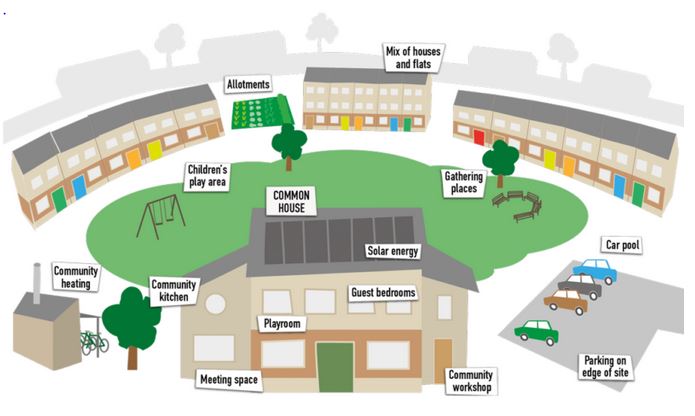
Example image of cohousing community

You can find out more about Cohousing by visiting the UK Cohousing network


Located in Bradley Green and set in 1.85 acres of beautiful Worcestershire Countryside, Lion & Lamb Cohousing offers like minded over 55's the opportunity to live in private, in a self contained property whilst at the same time being part of a caring, sharing community in a rural setting.

illustration of Lion and Lamb cohousing

Co-operative and tenant controlled housing

A housing co-operative is a housing organisation where members (tenants) democratically control and manage their homes. Housing co-operatives have open and voluntary membership and are independent of external organisations.

The Confederation of Co-operative Housing provides further details on co-operative and tenant controlled housing.

Development Trusts, Settlements and Social Action Centres

These are sometimes referred to as ‘community anchor organisations’ and they can be involved in a range of community projects including social, environmental and economic.
If you are one of these local organisations, we can support you to develop a community led scheme. If you want to find out more about community led housing in the Wychavon district or have a proposal you would like some support with please register your interest below or contact us at This email address is being protected from spambots. You need JavaScript enabled to view it.

Data Protection

The information you provide will be used solely for purposes related to developing community-led housing schemes within the Wychavon district. It is possible that your details may be shared with officers within other directorates of the council who are working on community-led schemes. The personal details you supply will not be shared with any third parties external to Wychavon District Council.

Affordable housing

In this section

One of our roles is to increase the supply of affordable new homes within Wychavon. We do this by working with a number of different partners. 

You can find out more information about who we work with to increase the supply of affordable homes on this page.

Housing Associations

Housing Associations are responsible for building and then letting or selling new affordable homes. The following housing associations are working hard to develop new affordable homes in our district:

Homes England and the Regulator of Social Housing

Homes England is a public body whose responsibilities include increasing the number of new homes built in England by providing funding to support their creation.

Find out more about funding for affordable homes on the Homes England website.

The Regulator of Social Housing is responsible for the regulation of ‘registered providers', such as housing associations, in England.

Developers and house builders

Section 106 Agreements

Many affordable homes on new housing schemes are built as a result of planning policies requiring them to be provided. In these cases, and also in the case of community-led schemes, developers are required to sign a legally-binding agreement to secure delivery of the required affordable homes. These agreements are known as planning obligations or Section 106 Agreements.

Planning Policy - Affordable Housing Threshold

The South Worcestershire Development Plan (SWDP) was adopted on 25 February 2016 and it included policies for seeking developer contributions towards infrastructure including affordable housing (Policy SWDP15). That policy requires affordable housing contributions from sites which include 1 dwelling or more, including conversions.

The Affordable Housing Supplementary Planning Document (SPD) was published in October 2016 and provides further guidance to developers on the councils approach relating to the delivery of affordable housing across the three south Worcestershire Councils (Wychavon, Malvern Hills and Worcester City).

In July 2018 the Government published a revised version of its National Planning Policy Framework (NPPF) (amended in February 2019) setting out a new national threshold for the provision of affordable housing.

The NPPF is a material planning consideration and the 2019 version post-dates the adoption of SWDP and the South Worcestershire Affordable Housing SPD. 

Types of affordable housing

The are many types of affordable housing. These include:

  • Affordable housing for rent through a housing association
  • Build to Rent (also known as Affordable Private Rent) – properties available to rent under the private rented sector. The rent levels are at least 20% below local market rents (inclusive of service charges if applicable) for the same or equivalent property. Usually, tenancy agreements of three years or more are offered. Find out more about Build to Rent on the Government's website.
  • Starter homes. If you are a first- time buyer, the Starter Homes scheme could help you buy a new-build home with a 20% discount. You must be below the age of 40.
  • Discounted market sales housing. This is where you purchase a home at a discounted rate which is usually at least 20% less than the market value, and when you come to sell, the property will be sold at the same discounted percentage. For a copy of the Discount Market Sales application form, please email This email address is being protected from spambots. You need JavaScript enabled to view it.
  • Shared ownership. This is where you buy a share of your home (between 25% and 75%) and pay rent on the rest. Shared Ownership properties can be purchased from a housing association. Find out more about shared ownership on the Government's website.

Shared Ownership Units for sale

Rooftop Housing Group are pleased to offer you an opportunity to purchase a shared ownership home in the popular location of Hampton, Evesham.

Each home will combine modern layouts with quality finishes, creating comfortable energy efficient living in a well connected location. Brook View is located in the picturesque, historic market town of Evesham which sits alongside the River Avon and beautiful Abbey Park. 

Brook View, Pershore Road, Hampton, Evesham - 2 bed mid terrace houses

Brook View, Pershore Road, Hampton, Evesham - 2 bed end terrace houses

Brook View, Pershore Road, Hampton, Evesham - 2 bed semi detached houses

If you would like to apply please review the attached pdf Shared Ownership Eligibility (51 KB) and if you meet the criteria, please complete the attached pdf Shared Ownership Application Form (350 KB) and return to This email address is being protected from spambots. You need JavaScript enabled to view it..

pdf Important Information for Applicants (236 KB)

Further information around shared ownership can also be found at Shared ownership homes: buying, improving and selling: How shared ownership works - GOV.UK (www.gov.uk).

If you have any queries, please do not hesitate to contact one of the sales team on 01386 420837 or This email address is being protected from spambots. You need JavaScript enabled to view it. 

Identifying housing need

As a council, we regularly assess and puts in place plans to meet local housing needs, including affordable housing needs.
We assess housing need by:

  • Strategic Housing Market Assessment
  • Housing Register data
  • Housing Needs Surveys

To address this need, we expect a percentage of most new housing developments to be affordable housing.

More detailed affordable housing requirements in terms of types, sizes and tenures are fixed on a site by site basis after considering: the housing needs of the district; any site-specific issues; and, in rural areas, the locality. However, as regards tenure, based upon the Strategic Housing Market Assessment the council normally expects the affordable housing to be 80% social rented and 20% intermediate housing products.

Housing needs surveys

We carry out rural housing needs surveys to help us understand the housing requirements in the district. The surveys are completed by households in the selected parishes. Each survey provides data that can be used to inform the planning of new housing developments and demonstrate the need for increased affordable housing.

Once the survey is closed, a report will be published and available on our website.

Discount Market Scheme (DMS)

Discount Market Sale (DMS) is a scheme to help low and middle earners get onto the property ladder, by providing full market value properties at a discounted price.

Are there any DMS units for sale?

To find out if there are any units available within the district to buy, they are marketed through the normal property selling sites or a developer.

Can I sell my Discount Market Scheme property?

You may sell the property at any time, but you must notify Wychavon in writing of your intention to sell your affordable home. In order to confirm the value of your property, you will need to obtain and provide the council with two written valuations for the full Open Market Value of the property from two reputable local estate agents. This must also be submitted on the estate agents headed paper. The sales value is then calculated and agreed upon by taking the average of these two valuations and applying the purchase discount. This is then the maximum sales value which you can sell at through your chosen estate agency.

These can be sent to This email address is being protected from spambots. You need JavaScript enabled to view it..

As this scheme is part of the Affordable Home Ownership scheme, prospective buyers must be eligible for affordable housing and satisfy the requirements of the original Section 106 agreement. The local connection eligibility details will be provided to the estate agent selling the property. Gross annual household income at the date of application for a DMS unit must not exceed £80,000 to be eligible.

The property must be sold with the same discount percentage that you received when purchasing the property, and valuations must be submitted to the Local Authority and a 70% Discounted Price agreed.

DMS Mailing List

If you are interested in Affordable Home Ownership, we hold a mailing list of people who would like to know when properties become available. If you would like to be added to this mailing list, please detail your local connection to a specific parish or district, and email your details to This email address is being protected from spambots. You need JavaScript enabled to view it..

First Homes 

First Homes is a scheme that is aimed at first time buyers at a discount between 30% - 50% but is only for first time buyers. Please follow the link below for more information:

First Homes scheme: first-time buyer's guide: Overview - GOV.UK

Are there any First Homes for sale?

To find out if there are any units available within the district to buy, they will be marketed through the normal property selling sites or via the developer.

First Homes Mailing List

If you are interested in Affordable Home Ownership, we hold a mailing list of people who would like to know when properties become available. If you would like to be added to this mailing list, please detail your local connection to a specific parish or district, and email your details to This email address is being protected from spambots. You need JavaScript enabled to view it..

Useful documents

Read Rural Lettings Policy 2021

Read more …Affordable housing

Specialist Advice

Some households who become homeless may have different pathways they can follow and will get specialist advice dependent on their situation. Wychavon District Council tries to consider everyone’s individual circumstance to ensure they get the support they need.

More information

Use the links below to find the information you need:

I am fleeing domestic abuse, who can help me?

If you are fleeing Domestic Abuse, we have a duty to support you to flee to emergency accommodation. This might be a Refuge or Interim Accommodation until we can work together to develop a permanent housing plan for you. Some options could include social housing, private rented accommodation or supported accommodation, depending on your circumstances.

Domestic Abuse is an incredibly scary and distressing situation. Housing Needs Advisors can support you to get the right support so you can work through the emotional impact of Domestic Abuse.

Support might include help from services like the National Domestic Abuse helpline website or Women's Aid website. This might also include local support services like the Dawn Project. Visit Domestic Abuse Working Network page on Worcester Community Trust website

I am a care leaver and I am homeless

Depending on your age and circumstances, we can help you with your accommodation and finances, as well as advice on how to live independently.

To qualify for the most help, you must have spent a total of 13 weeks in care from the age of 14. This must include at least a day when you were 16 or 17.

Help from the council's children’s services department can start when you turn 16 and last until you’re 21, or until you finish training or higher education.

As a care leaver aged between 18 and 20, you’ll be in priority need for emergency housing from the council’s housing department if you’re facing homelessness.

This applies even if you spent as little as 1 night in care when you were 16 or 17.

If you’re a 16 or 17-year-old care leaver and are homeless, the council will probably refer you to social services. But the housing department must provide you with emergency accommodation until children’s services can find you somewhere to live.

I am homeless and am or have previously been in the armed forces

The government has made a commitment to support ex-forces. It is committed to ensuring that service personnel, veterans and their families have the support they need and are treated with the dignity they deserve.

To deliver this commitment, the Armed Forces Covenant outlines the positive measures being taken by government to ensure that the Armed forces community face no disadvantage, compared to other citizens in the provision of public and commercial services.

View Armed Forces Covenant website

I am about to leave hospital but I don’t have anywhere to go

You should tell the hospital nursing staff as soon as possible, so that they know that you will be homeless when you are discharged. They will ask the hospital discharge team to help if they can.

The discharge team may refer you to our housing advice team. We will assess your situation and you may be offered temporary accommodation in certain circumstances. If you are within 56 days of discharge, and have no home to return to, our housing options team will support you whilst we decide if we have a duty to re-house you. We’ll also offer you advice and support.

I am about to be released from prison but don’t have anywhere to go

If you in prison and don’t have anywhere to go when you are released, you should let the prison team know as soon as possible. Most prisons have a housing advice and resettlement service called Through the Gate which is set up to help you find a suitable housing option when you are released from prison.

You can also apply for the grants before release; these include a £46.00 discharge grant or a £50 grant towards your first nights accommodation. You should let the prison team know as soon as possible if you want to access this.

If you are not allowed to stay at your old address because of your offence, prison staff may refer you to the Bail Accommodation Support Scheme who will help you find an address that is suitable. You can also contact NACRO’s Resettlement Advice Line on 03001231999 for further advice.

Our Housing Advisors will support you to understand both your emergency and long term options. We will work closely with probation and prison teams to support you to find a suitable accommodation offer.

I am over the age of 55 and am threatened with homelessness or homeless

If you are over the age of 55, you are eligible to apply for accommodation that is sheltered. Sheltered housing is accommodation specifically designed for older people to allow them to live independently.

It usually consists of self-contained flats with communal facilities. In most cases, it’s available to people aged over 60, although some schemes may be open to those over 55 years old. When used exclusively for older people, it’s sometimes called retirement housing. If the accommodation is part of a care home complex, it's also known as close care.

Housing Advisors will support you to apply for Sheltered Accommodation via our Housing Register, Home Choice Plus. You can read some more information on how this works on the Home Choice Plus website.

Relieving Homelessness

Are you already homeless and not sure what you need to do next?

There are several things the Housing Options Team can do to help you to resolve your housing issues.

If you are worried about becoming homeless then get in touch as soon as possible so we can help you to understand your options. If you are homelessness within the next 56 days then you can use our online self-referral form to make a homelessness application.

View online self-referral form

More information 

Use the links below to find the information you need:

How do I know if I am eligible to get support from the Local Authority?

We can provide different types of support for different people, however, if you are a person from abroad and unable to make a claim for benefits you may not be eligible for assistance from the council. This is not a general statement and it is always worth making a Homeless Application to find out.

Even if you are not eligible for formal assistance, you will be provided with advice about how to reconnect with your country origin or to seek legal advice to gain status in the United Kingdom.

We may also decide not to provide formal assistance if you are not homeless or threatened with homelessness within 56 days.

The homelessness law covers more than being out on the streets. You will be considered homeless or under threat of homelessness if:

  • You have nowhere to live in the United Kingdom or elsewhere.
  • You are afraid to go home because someone living there has been or may be violent to you or your family.
  • You have nowhere you can live together with all your family.
  • You do not have the owner's permission to stay, e.g. you are a squatter.
  • You have been locked out of your home.
  • You have somewhere to stay but it is not reasonable for you to do so, e.g. following violence, threats of violence or harassment.
  • Your home is a boat, mobile home or caravan and you have nowhere to put it.
  • You have been given Notice to Quit by your landlord.
  • You have been taken to Court by your mortgage lender for arrears and the Court has said you must leave.
  • You have been living with friends and they have asked you to leave.

Will I get Interim/Temporary Accommodation if I am homeless? 

We will, in some cases provide interim accommodation to homeless households. This will only happen if there is a reason to believe the household is homeless, eligible and in priority need. This is a form of emergency accommodation and is provided whilst we investigate what further duties might be owed to you.

If you are given interim accommodation it could be a hotel, a Bed & Breakfast or other forms of shared accommodation. We will try to find accommodation in the local area but sometimes we may have to move you away from your preferred area temporarily.

Whilst we know this accommodation is not suitable long term, it is designed to safeguard you in an emergency. However, we do commit to ensuring that families with dependent children are not placed in B&B or hotel accommodation for longer than 6 weeks.

If we do not think there is a reason to believe you are homeless, eligible and in priority need, they will not place you in interim accommodation. However, we can advise on other emergency options like friends and family.

What does it mean if I am owed the Relief Duty?

Once we have agreed that you are eligible and you are homeless, you will be owed the Relief Duty. This means that we will work closely with you for 56 days to support you to find new accommodation.

You will have a full assessment and Personalised Housing Plan, where we will agree on tasks that we can both do to resolve your homelessness problem.

Accommodation options could include:

What is priority need?

There are lots of homeless people across the UK. Some people need more help from the Council than others. Households that are considered to need the most help are households in priority need. To be considered to be in priority need, you must fit in to the following criteria:

  • Have dependent children living with them
  • Are pregnant
  • Are a person aged between 16-17 (unless a 'relevant child', or a child in need, owed a duty under s.20 of the Children Act 1989)
  • Are under 21, and in care or fostered between the ages of 16-18
  • Are 21 or more, and vulnerable as a result of having been looked after or fostered (except for 'relevant students')
  • Are vulnerable due to old age, mental illness or handicap, or physical disability
  • Are vulnerable due to having been a member of Her Majesty's regular naval, military or air forces
  • Are vulnerable due to having been in prison
  • Are vulnerable as a result of violence from another person, or vulnerable due to another special reason
  • Are homeless due to flood, fire or other disaster

What does intentionally homeless mean?

This means that we think you chose to leave a home which you could have stayed in, or that it was your fault that you lost your home, or you unreasonably failed to take up accommodation which was available to you.

This would apply if:

  • You chose to sell your home when there was no risk of losing it.
  • You lost your home because of wilful and persistent refusal to pay rent or mortgage payments.
  • You have neglected your affairs having disregarded advice from a qualified person.
  • You voluntarily gave up adequate accommodation in this country or abroad without first having found secure accommodation to move into, when it would have been reasonable for you to stay there.
  • You have been evicted for anti-social behaviour.
  • You have voluntarily resigned from a job with tied accommodation where circumstances indicate it would have been reasonable to continue in the employment.
  • You entered into an arrangement causing you to leave accommodation which was otherwise available to you.
  • When a homelessness application is made, the officer dealing with your application will have to check to see if you have deliberately done something or deliberately not done something that resulted in you becoming homeless. If you are considered "intentionally homeless", we may only have to provide temporary accommodation for a reasonable period of time, possibly 28 days, while you make your own arrangements to find alternative accommodation.

For specialist advice

Are you about to become homeless and in need of help?

The Housing Team can advise you about your rights and try to help prevent you from becoming homeless.

If you are at risk of homelessness within 56 days, please use our online form to make a homelessness application or browse the information below for advice.

Use the links below to find the information you need:

My relationship with the people I live with has broken down

A Housing Needs Advisor can give you advice around your rights. We can also advocate on your behalf with friends or family to try and arrange a suitable solution to keep you in your home. We can also refer you to more specialist support as a household which may include counselling to help you resolve and mitigate against any future problems. Family and friends are a vital support system and we will do all we can to help you sustain those relationships for the future.

I am renting from a private landlord and have been served a notice to quit

A Housing Needs Advisor can check your notice to make sure it is legally compliant and explain the contents if you are not sure. We will also negotiate with your landlord to try and rescue your tenancy wherever possible. We will also outline your options for alternative accommodation which may include other Private Rented Sector Accommodation or rented accommodation through Wychmove: our social lettings agency service. Learn more about Wychmove.

Citizens Advice and Shelter also have lots of helpful online tools to make you aware of your rights.

I am a young person and my parents have asked me to leave

Young people who are at risk of homelessness will sometimes have different options to people who are slightly older because they often have not held their own tenancy before. A Housing Needs Advisor and Young Persons Pathway Worker will work with you and your parents to try and mediate and keep you in your accommodation.

The Housing Team work closely with other partners to provide specialised advice to young people on their options and access the appropriate support. Some of these may include; the YMCA or Social Services.

I am renting my home but it is not fit to live in due to disrepair

If your property is in disrepair this can be very distressing and our initial advice would be that you try to report this to your landlord so they can complete the repairs. If the landlord fails to make the property habitable, the Private Sector Housing Team will work with you and your landlord to assess the property and work to get this repaired to an appropriate standard.

To contact the Private Rented Sector Housing Team, please call 01386565000 and press Option 4 to be directed to a member of the team.

I have mortgage arrears and I'm at risk of losing my house

Mortgage arrears are considered on a case by case basis. Housing Needs Advisors will support you to seek financial advice from our Financial Inclusion as well as specialist legal advice where appropriate.
Citizens Advice can also advise on mortgage arrears. They operate drop in services in Malvern, Evesham and Droitwich.

I have rent arrears and am at risk of losing my home

The Housing Options Team can give you personal advice and refer you to other agencies who may be able to help. They may also be able to assist you to apply for benefits or may be able to speak to your landlord to help prevent you from becoming homeless.

If you cannot pay your rent, you have missed rent payments or you are worried that your payments are not being made, sort things out as soon as you can. Even if you have other debts, make sure you deal with your rent arrears first.

Things to do to help you get back on track

Make a list of all your debts and identify the most important that you need to tackle first such as your rent, council tax, gas, water and electricity charges.

Write down all your income and expenses and work out a personal household budget to help you decide how much you can afford to pay to each of the people you owe money to.

Consider seeking advice from a debt advice agency such as National Debtline or Stepchange. You can also organise an appointment with our Financial Inclusion Officer who can support you with localised advice.

View National Debtline website

View Stepchange website

Most importantly, talk to your landlord - try to reach an agreement about paying off the arrears, but do not agree to pay more than you can afford.

I have received a summons calling me to court about a housing matter

It is very important that you attend court in order to make the judge fully aware of your personal circumstances. Housing Advisors can support you to understand what might happen in court and what your options are.

My home is no longer suitable because of an illness or disability

If you are a Housing Association Tenant, you should contact your Housing Officer at the earliest possible opportunity to discuss transfer opportunities or possible adaptations to your home.

If you own your own home or rent a property private, please contact Adult Social Care at Worcestershire County Council.

Get in touch

Still can't find what you're looking for?

Contact us for help with services not available online.
Wychavon - Background shape