

- Wychavon Growth Programme
- Inward Investment
- Town Centre and Tourism
- The Pillar business hub
- Business Rates
- Licensing
- Tides of Time
- Vivid Memories
Severn Trows, the boats constructed for use on the River Severn to transport goods around the region, were sailing cargo carriers which called at various ports and docks along the River Severn to Welshpool and for on-going transportation of goods across the English Channel.
Before the wide Barge Canal was completed, salt from Droitwich was probably once transported by boat along the River Salwarpe or as we know by road to Worcester. The 1714 Turnpike Act records the need for a toll road from Droitwich to Worcester due to the bad condition of the roads caused by transporting salt from Droitwich to Worcester. This toll road was the first in the county and underlines the importance of the Droitwich salt industry throughout history with its importance recorded amongst others during the Roman period, the Charter of King Aethelbald 716-7, and in the Domesday Book. Samuel Manley’s 1822 map of Worcester identifies a road named Salt Lane (now renamed Castle Street) probably where salt warehouses were located, close to the riverside but above the racecourse, an area regularly flooded by the river.
The Droitwich Barge Canal completed in 1771, was wide enough to accommodate the trows which were 14’6” wide and 64’ long. Trows were towed up and down the canal with the sails and the hinged masts lowered to go under the bridges by men as had been done for years, until 1806 when the proprietors agreed to make a tow path suitable for horses. The raised masts could have been used to assist with the loading and unloading of cargo along the docksides. Later with the construction of the narrower Junction Canal in 1854 connecting Droitwich to Birmingham and beyond the trows/barges became longer and narrower, some converted and others newly built.
The earliest trows were small flat-bottomed craft to be used on shallow water and were around from medieval times to the 1500’s. These may have been used on the River Salwarpe.
“A particularly important trade is said to have been the export of salt to Bristol during the winter to be stored for the fleet which then sailed thence in pre Reformation times to the Grand Banks and other fishing grounds to catch and salt fish for the Lenten fast: this would have gone by road to Worcester and carried down the Severn and up the Bristol and Avon by trows and barges, doubtless assisted by the winter flooding of the Severn”. (Hingley).
Prior to 1840’s the River Severn was tidal up to Worcester then later, tidal to Gloucester. Those operating in the tidal section were called Downstream Trows and those operating north of Worcester were smaller and called the Upstream Trows. Castle Street leading down to the River Severn in Worcester was once known as Salt Lane where the thriving Salt Market may have been located and at the dockside where salt transported to Worcester would have been transferred to the larger Downstream Trows to be transported around Britain and overseas.
The Upriver Trow was around during the Tudor period, and had a flat bottom and a square sail. Most were about 18m long and 4m wide and could carry 20-40 tons. Many became specialised and included the Wych Trow (sometimes known as Wich Barges) that carried salt from Droitwich. As they were low in the water and open, it is improbable that they would have been used in the open seas where the cargo of soluble salt was likely to have been washed away, but they have been recorded as voyaging to Bristol and other estuary ports which required the registering of the trows in the Ships’ Register, and these “open” hulled trows were banned from trading from a line west of Barry to Watchet. Other Upriver trows included the Wye and Stroud barges.
By 1850, Estuarine Trows appeared generally operating in the Severn Delta, and then the Sea-going trow came into use from 1900 with the last working until 1939. The Spry survives in Ironbridge Museum.
The Droitwich Salt industry depended not only on the export of common salt across the country and further afield, but also for the import of coal from Staffordshire and the Forest of Dean for the boiling of brine to make crystalline salt. The Salt carrying trows generally returned empty to preserve the purity of the salt, but in cases of “back” cargo it would be a “clean” commodity such as wheat.
Some of the trows 64 shares were jointly owned, but many were owned by one or two owners or by companies. In 1841, Edward Everton, Tailor is recorded as the sole owner of Hercules. Of the 195 identifications and owners recovered to date and recorded by Hingley (see below), 75 were called Harris, and 29 by the Everton family. Companies listed were the Droitwich Salt Company, the Droitwich Patent Salt Company, Clay Newman and Co., and eventually the Droitwich Salt Union. Sixty-four vessels with Droitwich connections from the 1902 Ships Register survives and are listed below. Of these vessels, twenty are recorded as having been wrecked or sunk.
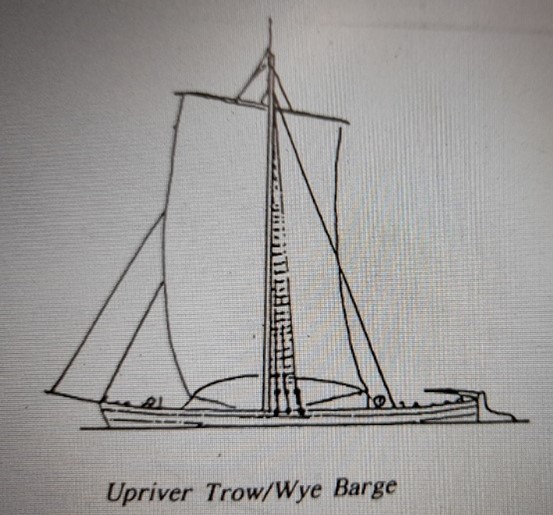
The Severn Trows had hinged collapsible masts which were lowered when going under bridges along the River Severn.
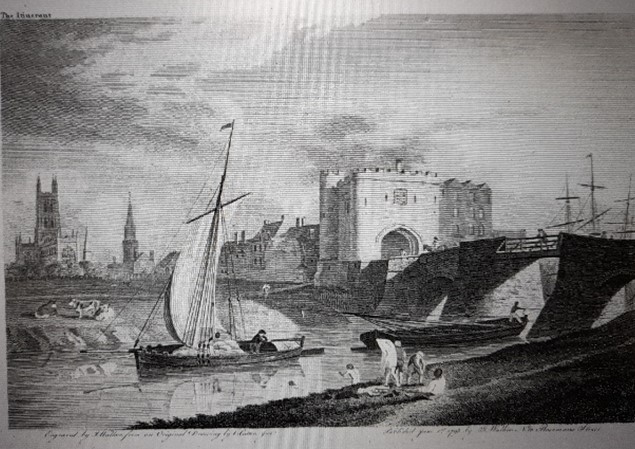
These sea-going trows were etched in 1798, one with a lowered sail going under a bridge at Gloucester, and the other with sail raised.
The 1833 Buckler sketch of the salt wharves at Droitwich shows an upstream trow in the foreground moored along the canal-side dock in the town below St Augustine’s church, and in the background on the canal a square-sailed upstream trow in sail. It is thought that the upstream trows probably remained square rigged until their disappearance.
%20-%20The%20Nelly%20Copson%20Archive%20Collection.jpg&folder=Images%2FBusiness%2FStreet%20Art%2FTide%20Time&container=fileman-files "British Library, Manuscript Collections (36393 p8) - The Nelly Copson Archive Collection")
Severn Trows moored in Droitwich are pictured with sails down and safely stored, alongside the salt warehouses or at canal-side moorings. One image shows Priory House in the background.
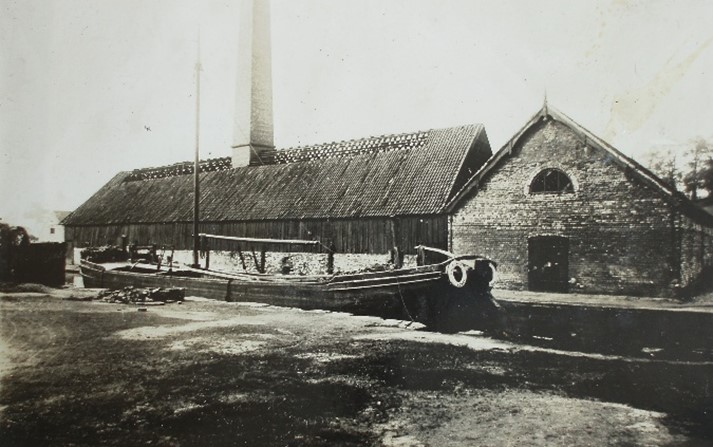
The Success, built in 1826 weighing 30 tons
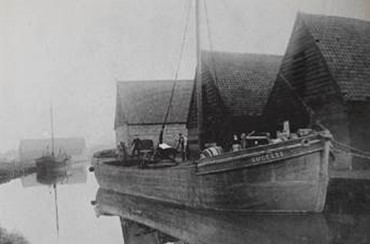
The Henry at Rickett’s Lane
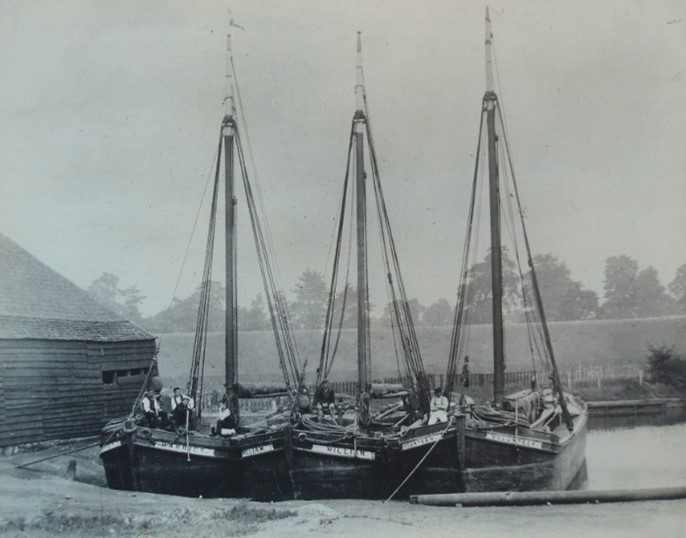
Harriet, William built 1891, and Volunteer moored at Droitwich Basin 1904
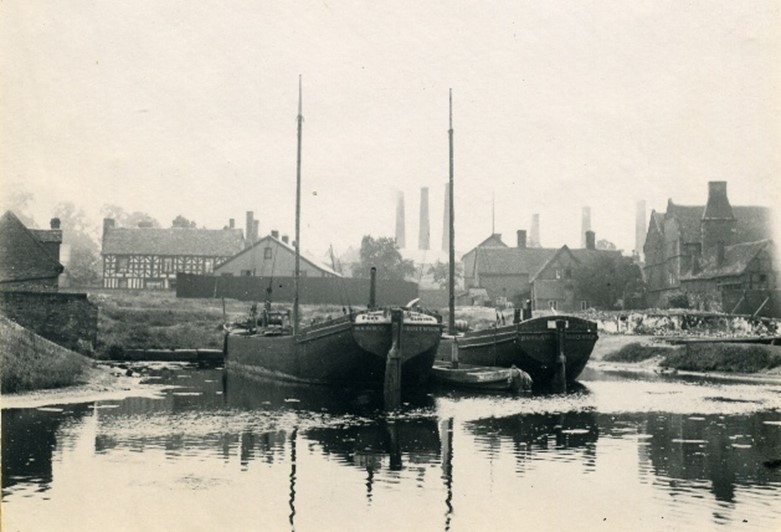
Priory House is in the background.
One of the Wych Barges is recorded as carrying 90 tons of salt from Droitwich to France.
The canal was disused by 1918, as salt production was by then principally at Stoke Prior and generally carried by railways.
An article appeared in the 1957 ICI magazine recounting the last days of the last eleven working trows of the company’s fleet when disbanded in 1918. Recalling the words of George Harry Pittaway a mate to his father on the on the “Britianna” that in 1918 “even by modern standards life on these primitive craft was not so bad. A normal trip to Gloucester or Avonmouth and back would last seven or eight days. They took their food from home. With 65 tons of salt on board, a barge was horse-hauled to Hawford. In the river water another 35 tons would be taken on bard from a small canal boat. The men with a strap round their shoulders attached to a line would “bow-haul” their barge to Worcester. In winter, with the river in spate they would row their vessel down. A tug took them from Worcester to Sharpness. Here they would hoist sail to Avonmouth. The trip from Droitwich to Bristol was made in three daily stages. At night they bunked down in the barge at Worcester, Gloucester and Avonmouth.
Last recorded bargemen with their nicknames when the fleet disbanded in 1918.
|
Britannia |
George “Skipper” Pittaway |
Mate: George Harry Pittaway |
|
Morland |
John “Morland Jack” Pittaway |
|
|
Success |
John “Cuckoo” Pittaway |
|
|
Ripple |
William “Dukes” Harris |
|
|
Victory |
William “Scraggy” Harris |
|
|
Industry |
William “Thummy” Harris |
|
|
William |
Joseph “Joe Tom” Harris |
|
|
Harriet |
Captain: Fred “Bargeman Fred” Harris |
|
|
Harry |
William Bourne “Dandy” |
|
|
Hastings |
William Bourne “Panto” |
|
|
Volunteer |
Skipper: George “Spring” Harrison |
|
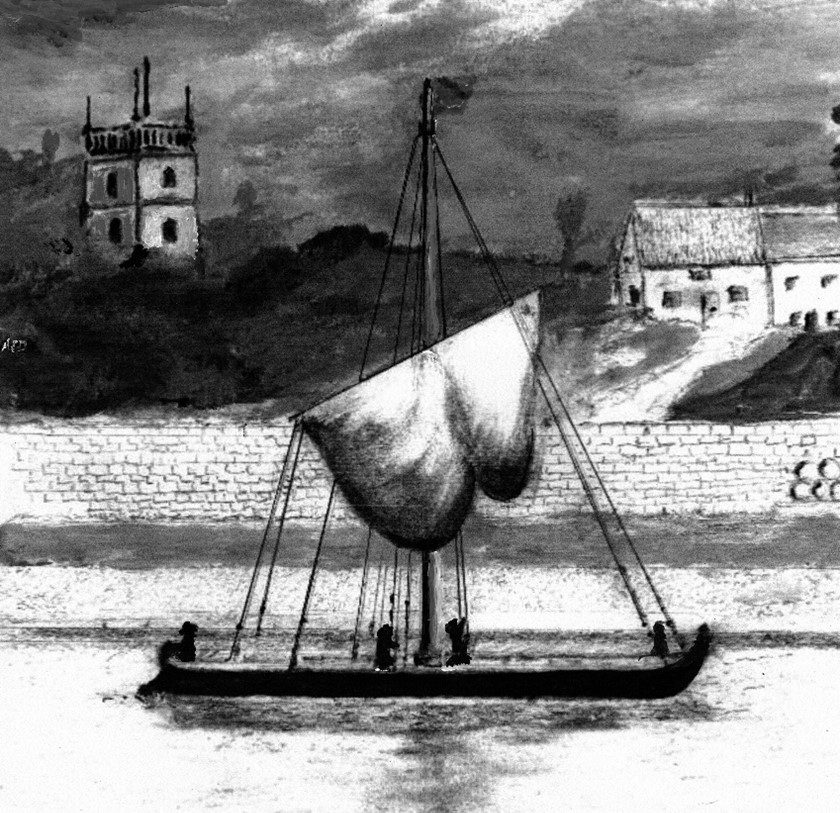
A trow illustrated at half-mast c.1880 - original drawing by Alan Davey 2025.
List of Droitwich Owned Trows and Barges (dates converted/sold/lost not included below, but listed by Hingley).
|
Name |
Date |
Weight (in tons) |
Owner |
|
ALBION |
1821 |
56 |
Harris |
|
BETSEY |
1839 |
28 |
Harrises |
|
BLAINA |
1834 |
55 |
Bought 1884 by Evertons |
|
BRITANNIA |
1839 |
25 |
Harris |
|
BRITISH QUEEN |
1839 |
25 |
Harris |
|
CAROLINE |
1834 |
25 |
Evertons |
|
CAROLINE |
1841 |
28 |
Evertons |
|
COMMERCE |
1828 |
57 |
Clay, Newman and Co, later Droitwich Patent Salt Co |
|
CYRUS |
1840 |
29 |
Evertons |
|
DEFIANCE |
1825 |
59 |
Everton then Droitwich Salt Co |
|
HENRY |
1829 |
60 |
Harris |
|
HENRY |
1862 |
29 |
Stourport “Gentleman” and Worcester “Gentleman” |
|
HERCULES |
1840 |
25 |
Evertons |
|
HOPE |
1802 |
45 |
Groves (inland use only) |
|
INDUSTRY |
1811 |
55 |
Graves |
|
INDUSTRY |
1818 |
24 |
Corbett |
|
INDUSTRY |
1883 |
36 |
Harris |
|
INVINCIBLE |
1826 |
22 |
Droitwich Salt Co |
|
JUNO |
1828 |
56 |
Caly, Newman and Co, then Droitwich Salt Co |
|
MARTHA |
1840 |
24 |
Droitwich Patent Salt Co |
|
MARY |
1812 |
56 |
Harris |
|
MARY ANN |
1827 |
24 |
Everton, later mortgaged to a Droitwich salt manufacturer |
|
RICHARD |
1835 |
26 |
Droitwich Patent Salt Co |
|
RIPPLE |
1895 |
41 |
Salt Union |
|
ROSE |
1868 |
33 |
Harrison |
|
SAFETY |
1839 |
30 |
Harris |
|
SISTERS |
1820 |
58 |
Owned in Pershore, then Harris of Droitwich |
|
SPEEDWELL |
1840 |
28 |
Harris |
|
SUCCESS |
1825 |
66 |
Harris |
|
SUCCESS |
1826 |
66 |
Droitwich Patent Salt Co |
|
SUCCESS |
1861 |
30 |
Harris |
|
SURPRISE |
1813 |
72 |
Harris |
|
SURPRISE |
1841 |
26 |
Harris |
|
THOMAS |
1837 |
23 |
Droitwich Salt Co |
|
TWEED |
1813 |
28 |
Gloucester, Bristol, Bath salt dealers, Bristol, Droitwich Salt Union |
|
UNION |
1837 |
21 |
Harris |
|
UNION |
1841 |
23 |
Gloucester, then Everton |
|
VICTORY |
1877 |
23 |
Harris |
|
VOLUNTEER |
1871 |
37 |
Harris |
|
WESTCROFT |
1863 |
33 |
Harris |
|
WILLIAM |
1819 |
59 |
Harris |
|
WILLIAM |
1891 |
29 |
Harrison |
|
WONDER |
1856 |
21 |
Coalbrookdale, then Harris of Droitwich |
References
Droitwich Canals Trust 2011 – The Droitwich Canals
Blewitt, Lyn & Field, Bob 1994 – Droitwich A Pictorial History
ICI magazine 1957 page 3
Hingley, Peter 2000 - Some Droitwich Sailing Barges, Worcestershire Archaeological Society Transactions, pp235-51, 3rd series vol 17, 2000
Hughes, Pat and Leech, Annette 2011 – The Story of Worcester
Trinder, Barrie - Barges and Bargemen
www.canaljunction.com/heritage/craft/severn_trow.htm
www.snr.org.uk (The Society for Nautical Research)
https://www.gloucestershire.gov.uk/media/2ean3dyd/5-2a-the-severn-trow.pdf
Wikipedia
Droitwich History & Archaeology Society June 2025.